National Day of Action
October 26, 2026
Defend Our Rights. Stand Up For Our Future.
Why October 26? Prime Minister Mark Carney has confirmed that the First Nations–First Ministers’ Meeting will take place on October 26, 2026, in Ottawa — framed as a “historic opportunity” by federal and AFN leadership, but for grassroots people, a moment of both danger and possibility.
Justin Trudeau’s “Framework” legislation on “Rights Recognition” (now Mark Carney’s) is a direct threat to First Nation Peoples Right of Self-Determination. It needs to be stopped and be restarted with the People from the ground up.
Protect Aboriginal Title & Treaties — our lands and agreements must be respected.
Defend Self-Determination — we are Nations, not municipalities.
Stop Extinguishment Policies — no to fee-simple land conversion or termination frameworks.
What’s at stake
Our Lands and Territories — without Title, we lose control.
Our Sovereignty — governments aim to redefine our Nations.
Our Future Generations — they inherit what we defend today.
Our Demands
- Recognition and Respect for Aboriginal Title, Inherent Rights, and Treaties.
- A New Policy Framework based on Nation-to-Nation relations, not federal delegation.
- Restoration and Restitution for lands and resources taken without consent.
Background
The policies behind this moment
This isn’t new. Advocates trace today’s federal approach back to the 1969 White Paper on Indian Policy — and argue the same objectives are being pursued today under different language. These are summaries; read the full source documents in the Resources section below.
White Paper 2.0 — What Our People Need to Know
The big message: for over 50 years, the federal government has been trying to end “Indian” status, turn First Nations into small local governments, push First Nations into the same system as towns and municipalities, and move away from Treaties and Nation-to-Nation relationships. This plan started in 1969. It never stopped. Today they call it “Reconciliation.”
What is White Paper 2.0? It is the modern version of the 1969 plan. It tries to change who is considered “status Indian,” change how Bands are governed, change how land is controlled, change how Treaties are understood, and move First Nations into a provincial-style system. This weakens our Nations.
Our rights are connected: status, Band membership, reserve land, Treaty rights, and our ancestral territories rise or fall together. If one is weakened, all are weakened.
What’s coming October 26, 2026: this meeting could lock in municipal-style governance, focus only on services (water, policing, social issues), and ignore land, Treaties, sovereignty, and real self-determination. If the meeting only talks about “services,” we lose ground.
Questions communities must ask: Who loses status? How does this affect our future generations? Are we in any federal negotiation tables? Have members seen the agreements? Do they protect our Treaty rights? Who speaks for us at the meeting? What are our non-negotiables? How do grassroots people get involved?
Source: White Paper 2.0 — What Our People Need to Know (PDF)
Bill C-15 / UNDRIPA (“CANDRIP”)
“Assimilation and termination have been central to the Indian Act since 1876… and remain very much alive today.”
Canada’s residential schools were not accidents — they were federal policy designed for assimilation and termination. Those objectives never ended. Today, they reappear through new legislation and bureaucratic restructuring.
Bill C-15 (CANDRIP): a false implementation of UNDRIP. Bill C-15 claims to implement UNDRIP — but instead domesticates Indigenous rights into narrow federal definitions under section 35. It embeds the Rights Recognition Framework that First Nation leaders rejected in 2018.
- Limits rights to federal interpretations
- Converts First Nations into “Indigenous-Canadians”
- Uses the 2007 UNDRIP text rewritten by states, not the original 1994 Indigenous-approved version
“Bill C-15 is based on a lie.” — Charmaine White Face
Co-optation & control: Canada secured support from the AFN, Métis National Council, and Inuit Tapiriit Kanatami through MOUs, funding, and bilateral mechanisms. During the pandemic, AFN assemblies were manipulated to block debate on resolutions opposing or qualifying Bill C-15 — chiefs were prevented from speaking, the virtual platform was controlled, and no resolution was allowed on the floor. This bypassed the actual rights holders: First Nations Peoples and Nations.
The call to action: reject Canada’s termination framework. True implementation requires remembering the original 1994 UN Declaration as a guide to international rights, recognizing Inherent sovereignty and Treaty relationships, ending federal policies of assimilation and termination, and ensuring First Nation Peoples — not federal proxies — lead the process.
Source: Why Bill C-15 (UNDRIPA/CANDRIP) Is Not Real UNDRIP Implementation (PDF)
Response to the 2026 Federal Progress Report
The 2026 UNDRIPA/CANDRIP Annual Progress Report on Termination of Treaty & Inherent Rights presents administrative activity, not rights implementation. It highlights federal processes — committees, consultations, pilot projects — while avoiding the structural changes required to align Canadian law and policy with UNDRIP, Treaty obligations, and Inherent First Nations jurisdiction and the international right of self-determination. This is not a rights-based progress report. It is a federal White Paper 2.0 (Termination of Collective Rights) compliance document.
Progress is defined as federal activity, not rights fulfillment. The report celebrates advisory committees, coordination tables, and service-delivery pilots. It does not address land restitution, jurisdiction transfer, free, prior and informed consent (FPIC) in resource development, reform of the Indian Act on First Nations’ own terms, or fiscal autonomy and revenue-sharing.
Consultation is not consent. The report repeatedly cites “consultation and cooperation” with 70+ Indigenous partners. But consultation is not the same as FPIC, which requires the right to say no, First Nations decision-making authority, and authentically shared or First Nations-led governance.
Bottom line: the report protects federal authority while presenting incremental administrative actions as meaningful progress. It does not demonstrate legal transformation, jurisdictional recognition, land restitution, or FPIC-based governance.
This is why the Truth Before Reconciliation Network is calling for a National Day of Action on October 26, 2026, to coincide with the scheduled First Nations–First Ministers’ Meeting in Ottawa — to send a message to Canada’s First Ministers, and our own First Nation Leaders, that we want fundamental changes to the First Nations–Crown relationship, not symbolic performative actions.
Source: Response to the Federal CANDRIP Termination Report (PDF)
Where negotiations are already underway
As of March 2026, federal–First Nations–Métis–Inuit negotiation tables exist in every region: 52 in British Columbia, 8 in Alberta, 13 in Saskatchewan, 13 in Manitoba, 20 in Ontario, 14 in Quebec, 10 in the Atlantic, 2 in Nunavut, 11 in the Northwest Territories, and 7 in Yukon.
Source: Federal Negotiation Tables by Region, March 2026 (PDF)
What real self-determination looks like — true Nation-to-Nation: our Nations are sovereign; Treaties are honoured; our lands taken without our consent are returned, or compensation given for lands not returned; no provincial veto; no delegated authority; funding based on rights, not “own-source revenue”; our laws and traditions respected. Anything less is not self-determination.
National Day of Action
How to take action
-
March on Ottawa
Gather at the First Nations–First Ministers’ Meeting venue.
-
Local Rallies
Organize community events and teach-ins.
-
Bridge & Road Demonstrations
Peaceful visibility actions.
-
Social Media Blitz
Share messages, photos, and videos using hashtags below.
Resources
Posters & printable materials
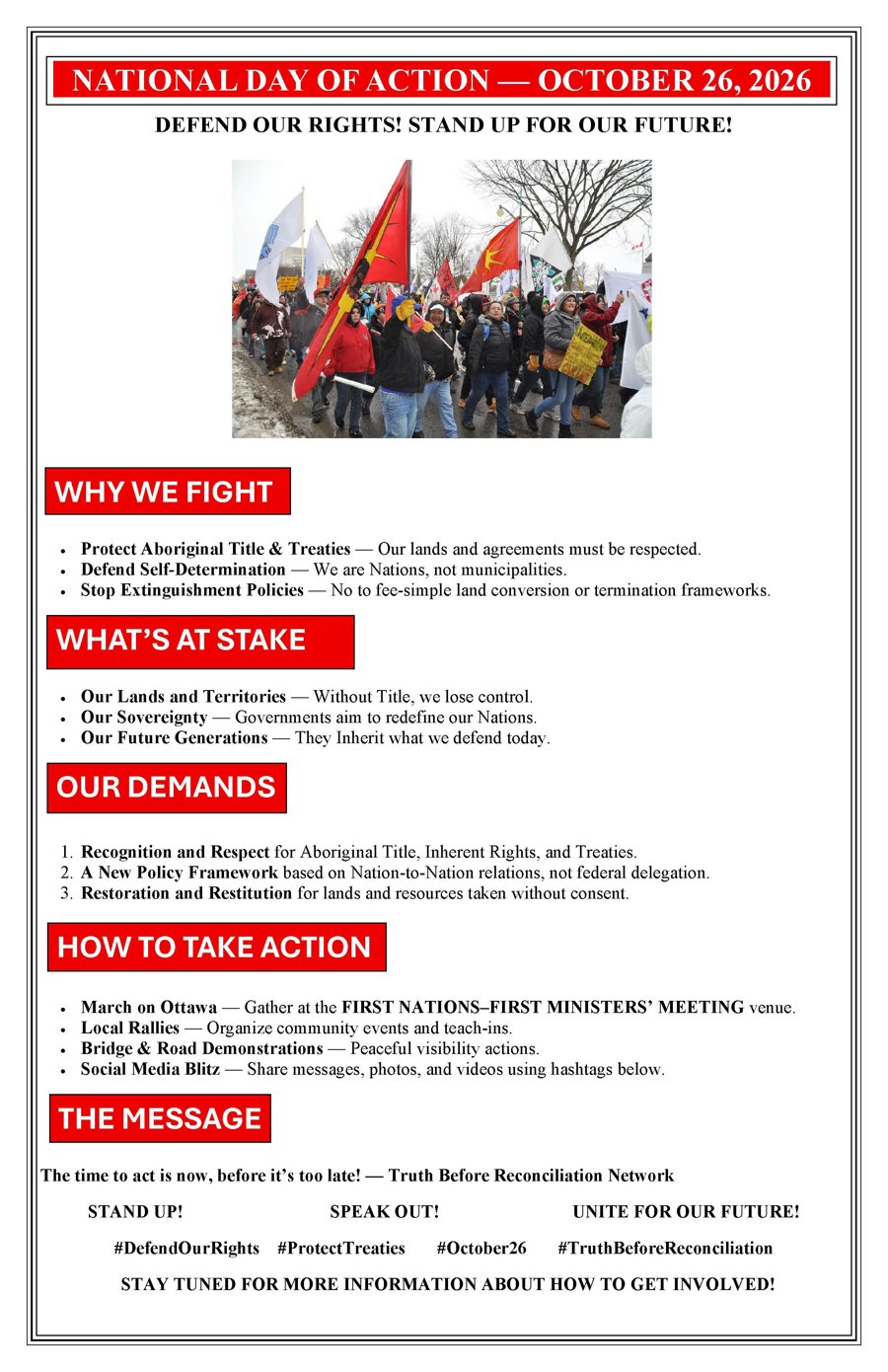
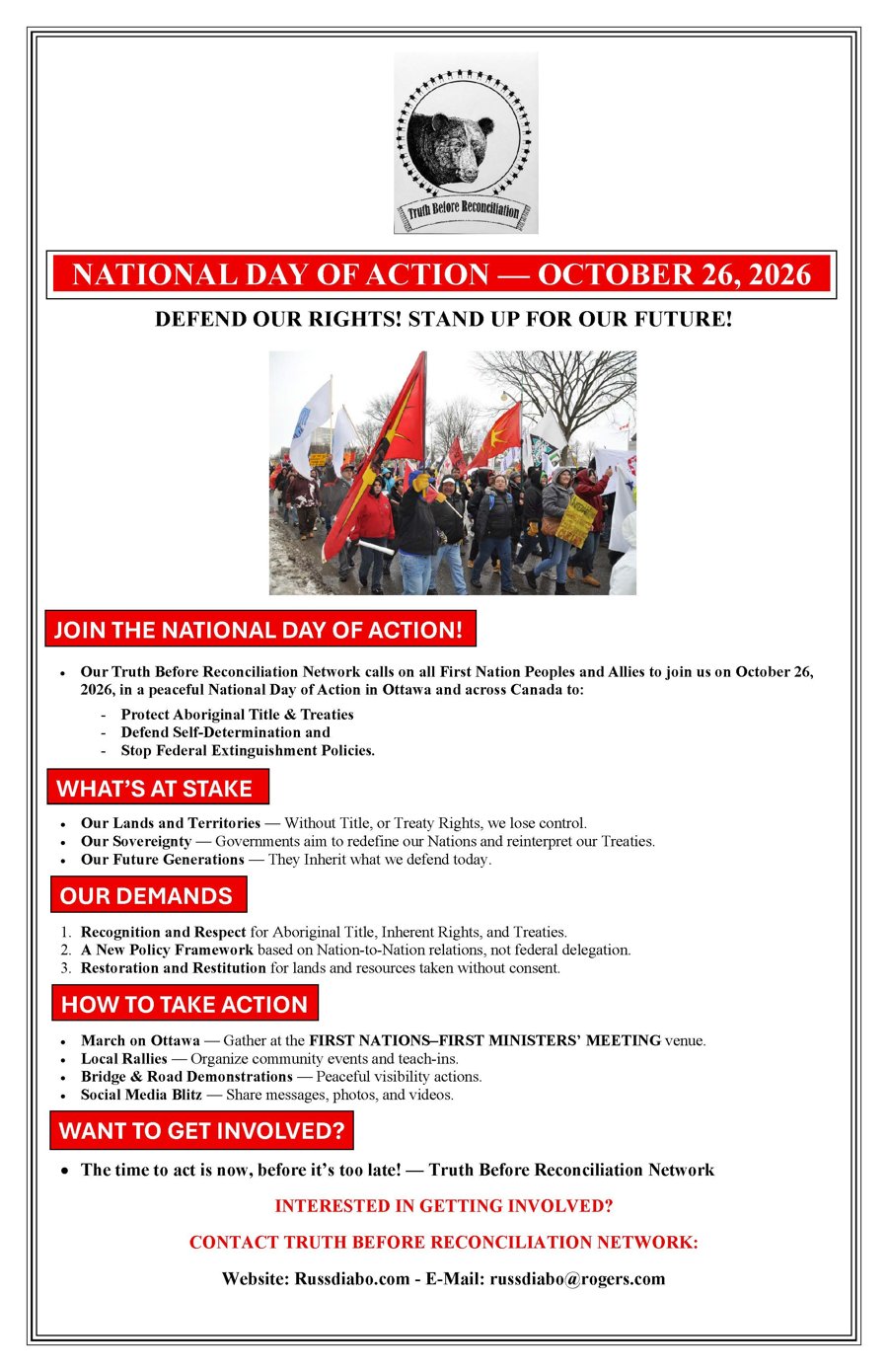
Download, print, and share. More materials will be added as the day approaches.
Get Involved
The time to act is now, before it’s too late.
Contact the Truth Before Reconciliation Education & Advocacy Network to get involved, ask questions, or share what your community is planning for October 26.